Retrieval-Augmented Generation With Graph Neural Networks
Graph neural networks identify relevant facts across documents without decomposing questions.
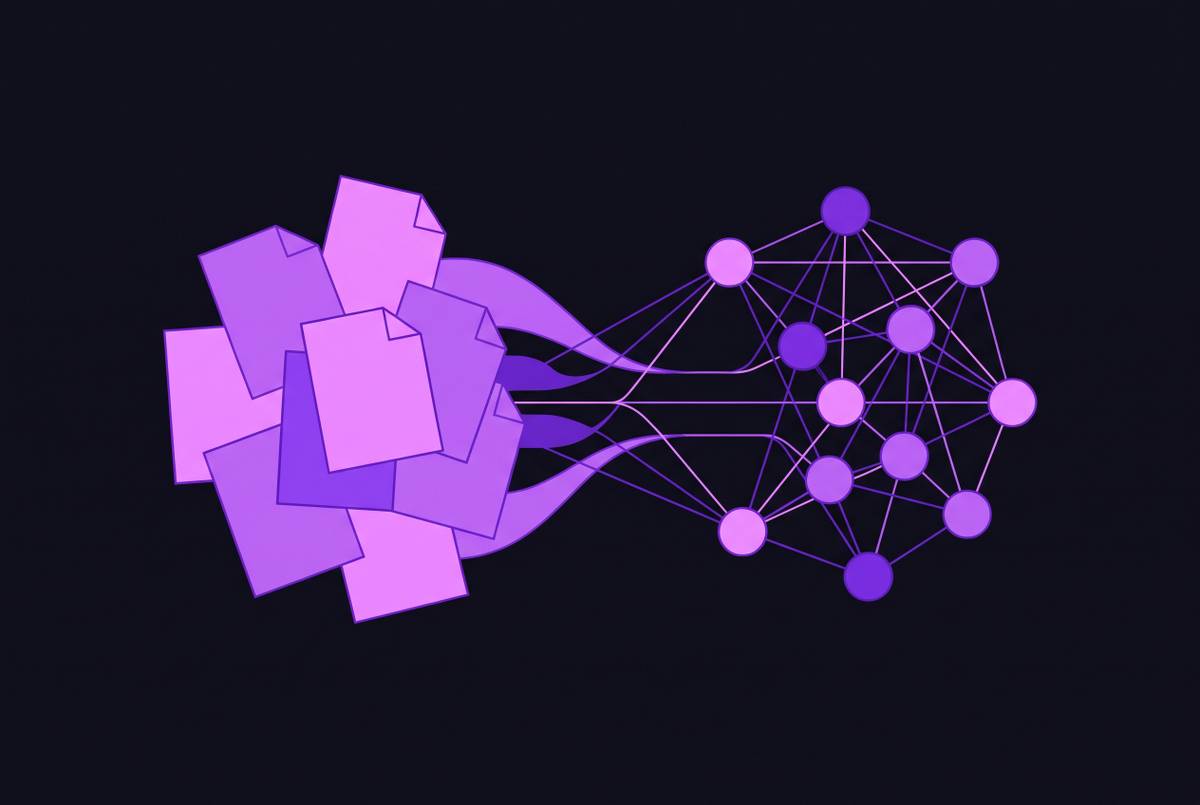
Standard retrieval-augmented generation turns a question into a vector, pulls back the top-scoring chunks of text, and hands them to a language model. That works fine when the answer sits in one paragraph of one document, and it falls apart the moment an answer requires connecting facts scattered across different documents. A vector index measures similarity, not relationship, and multi-hop reasoning runs on relationship. This piece looks at what happens when graph neural networks get folded into that pipeline, and argues that the popular workaround for multi-hop retrieval (breaking a question into sub-questions) is a patch on a design flaw, not a fix for it.
Take a question like "which drug interacts with a protein that's also targeted by a treatment for disease X." No single passage answers that. The system has to pull one fact from a pharmacology paper, another from a clinical trial writeup, and connect them correctly. Decomposing the question into sub-questions and answering each in isolation sounds reasonable, but it fails because each sub-answer gets treated as independent, the connective tissue between documents never gets modeled, and a small error in an early step compounds by the time the system reaches a final answer. That compounding failure is the actual argument for graph structure, not a preference for fancier tooling.
What knowledge graphs add that vector indexes cannot: entities, edges, and retrieval granularity
A knowledge graph makes the relationship the point, not an afterthought. Nodes are entities, edges are typed relationships (treats, causes, works-for, interacts-with), and that structure is explicit rather than something a model has to guess at because two words happened to land near each other in a paragraph. A vector index has no equivalent move. It can tell you two chunks are semantically close. It cannot tell you that one entity regulates another, or that a company's subsidiary filed a specific patent.
GraphRAG, as a category, brings three things a flat vector index simply doesn't have. A graph-structured representation of knowledge captures entity relationships and domain hierarchies instead of flattening everything into isolated chunks. Graph-aware retrieval can walk from one entity to a related one and keep the context of that hop instead of losing it. And search guided by the graph's own structure holds up once a corpus gets large enough that brute-force similarity search turns slow and imprecise.
Retrieval granularity is where the real tradeoffs live, and this is where most teams get it wrong by defaulting to "more graph is better." A system can retrieve at the level of a single node, a triplet (subject, relation, object), a full path connecting two entities, or an entire subgraph. Each choice trades context richness against token cost: a subgraph hands the model more to work with but burns through the context window fast, while a triplet stays compact but can drop the surrounding detail that makes the fact interpretable. Bigger retrieval units aren't the safer default; they're usually the more expensive way to bury the answer in noise. A conversion problem causes all of it: language models read sequences of tokens, not graphs, so the graph has to become text at some point. That verbalization step can quietly throw away the exact topology that made the graph worth building in the first place, which is a real part of why naive graph-to-text approaches don't reliably beat simpler methods.
How GNNs function as structured reasoners inside the retrieval pipeline
A graph neural network's job is to decide which part of the graph matters before the language model ever sees a prompt. Treat it as a filter that reasons over dense subgraphs, narrowing a potentially enormous knowledge graph down to the handful of nodes and edges actually relevant to the question, so the LLM keeps doing what it's actually good at: turning retrieved facts into fluent language, not hunting for them.
The mechanism doing the work is message passing. A GNN updates each node's representation by pulling in information from its neighbors, then repeats that over several iterations, so information from two, three, or more hops away eventually reaches a given node without anyone loading the entire multi-hop subgraph into a prompt. That's a real efficiency gain: the reasoning about distant connections happens inside the network's weights, not inside the token budget.
On top of message passing, the GNN learns importance weighting, a way of scoring how relevant a node is based on both its direct connection to the question and how relevant its neighbors already look. That lets the system reason several hops deep without the context window exploding, because it only has to surface the handful of nodes that scored highest, not every node it touched along the way.
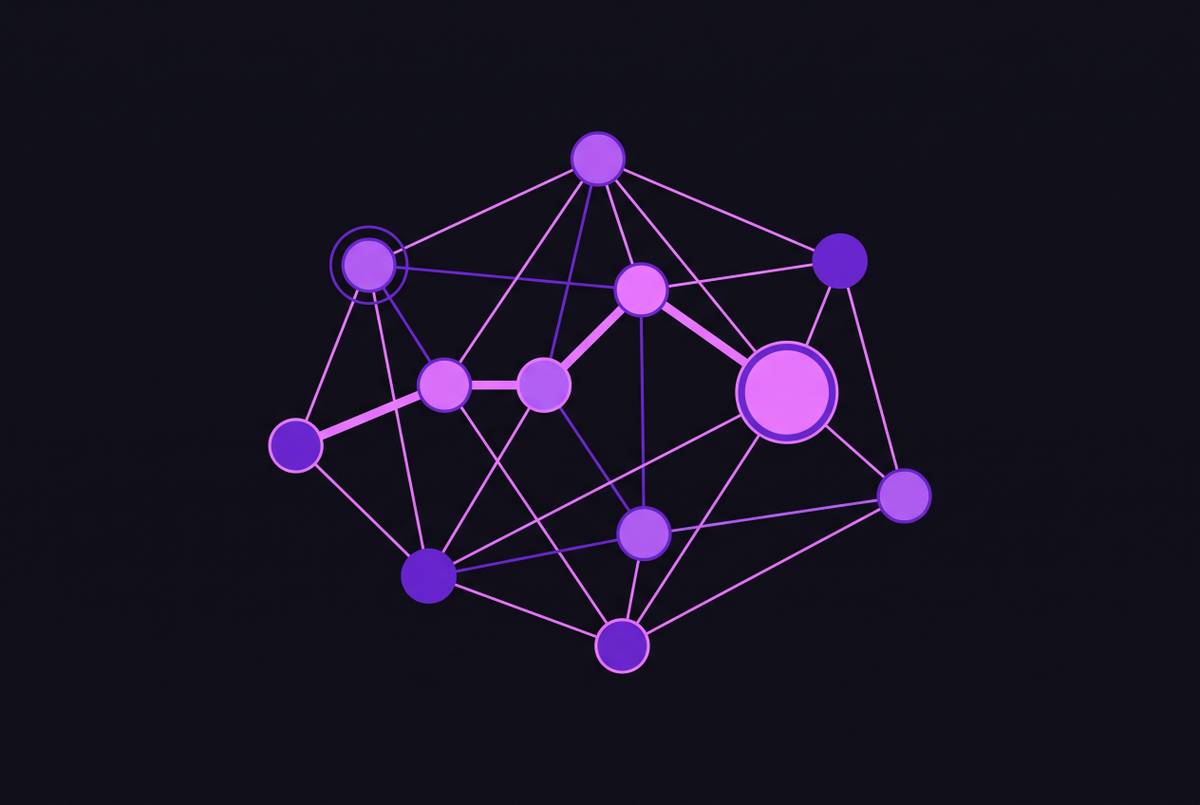
GNN-RAG shows a clean version of this end to end. Once the GNN flags which nodes look like likely answer candidates, the system extracts the shortest path connecting the question's entities to those candidates and passes just that path to the LLM. It's compact, it's interpretable (a human can trace the path and check it), and it burns far fewer tokens than dumping a whole subgraph into the prompt.
The main GNN-integrated RAG architectures and what each one does differently
Microsoft GraphRAG builds its knowledge graph using the LLM itself, in three phases: entity extraction with GPT-4, relationship mapping, and community detection with the Leiden algorithm to build hierarchical clusters of related entities. That community structure is the whole point. GraphRAG targets global summarization queries, questions about themes across an entire corpus rather than a single fact, and the community-level summaries let it synthesize across the whole document graph instead of chasing one passage. Microsoft reported 86% comprehensiveness on complex multi-entity queries against 57% for a traditional vector RAG baseline on the same evaluation set. The project went open-source in July 2024, and the broad community uptake since then says something about how much appetite existed for this approach. Since the graph comes from LLM extraction, hallucinated or noisy connections slip in and then propagate downstream through every later retrieval. That's the real cost of letting the LLM build its own map.
G-Retriever takes a different angle. It integrates GNNs, LLMs, and retrieval together, fine-tuning the system with soft prompting so it understands graph structure more directly. Retrieval is framed as a subgraph optimization problem, picking a connected subgraph that maximizes relevance to the query while keeping it small, which hands the system explicit control over how much context reaches the LLM. It's built for textual graphs: scene graph understanding, commonsense reasoning, knowledge graph QA, and it introduced the GraphQA benchmark to test across those domains. It scales reasonably well as graphs grow, and it shows real hallucination reduction on textual graph tasks specifically.
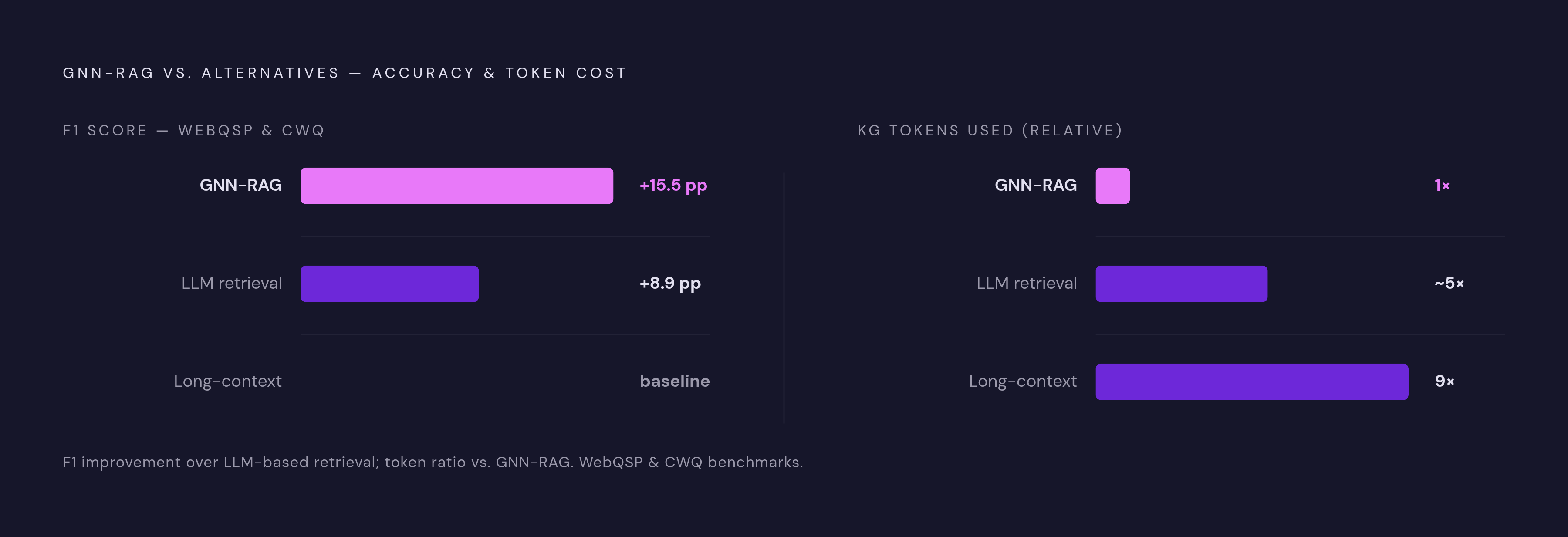
GNN-RAG stays deliberately lightweight by comparison. Its GNN scores node importance using both the node's relevance to the question and its neighbors' relevance, then retrieves the shortest paths from question entities to the GNN's answer candidates as context for the LLM. On the WebQSP and CWQ benchmarks, it matches or beats GPT-4 while running on a much smaller 7B tuned language model, and it outperforms LLM-based retrieval approaches by 8.9 to 15.5 percentage points on answer F1, using nine times fewer knowledge graph tokens than long-context approaches that just stuff more text into the prompt. It needs training from scratch on every new dataset, which caps how easily it generalizes to a domain it hasn't seen before.
GFM-RAG and its successor G-reasoner exist specifically to close that generalization gap, and this direction outpaces the other two. GFM-RAG is a graph foundation model built around a GNN that reasons over structure to capture how a query relates to the knowledge graph, with a relatively modest parameter count. It went through two-stage training across 60 knowledge graphs (well over a million triples, counted several times over) and 700,000 documents, and the payoff is the first graph foundation model that works on datasets it's never seen, with no fine-tuning required. It posted state-of-the-art results across multiple multi-hop QA datasets and domain-specific RAG datasets. Its follow-on, G-reasoner, has been accepted at ICLR 2026, with a larger 34-million-parameter pre-trained version released in April 2026.
Where graph construction itself becomes the bottleneck
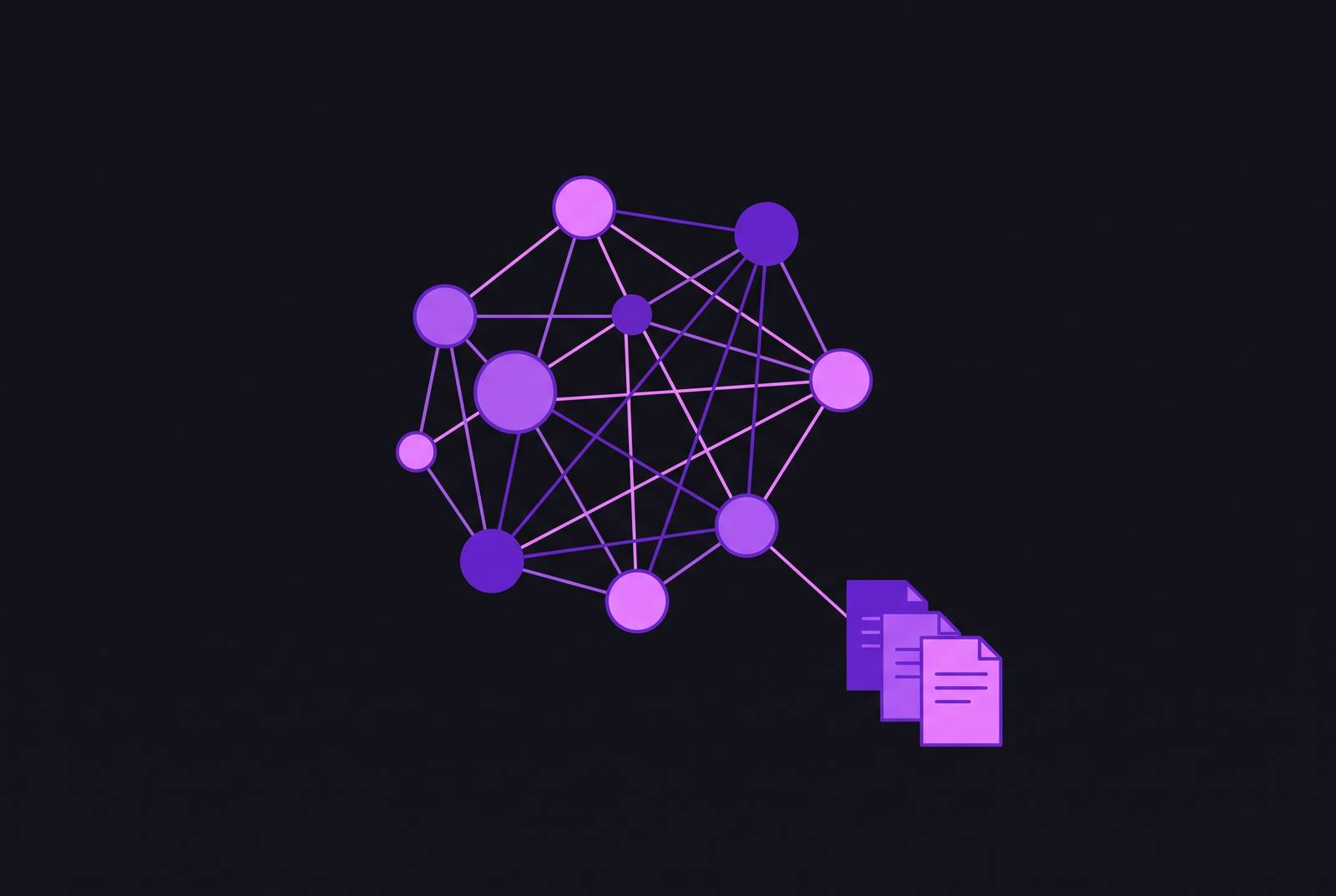
None of this works without a graph, and building one is where the real engineering cost hides, quietly, long before any query gets answered. The typical pipeline runs source documents through named entity recognition and relation extraction, using either dedicated deep learning models or LLM prompting, to produce nodes and edges. That's a meaningfully bigger lift than the ingest-and-embed workflow a standard vector RAG system needs, and it adds both time and cost upfront.
LLM-built extraction pipelines carry a specific fragility. They can hallucinate connections that don't exist, miss connections that do, or introduce noise a human reviewer would catch instantly but an automated pipeline won't. And because everything downstream depends on the graph being right, an error introduced at construction time doesn't stay contained: it propagates, and the LLM ends up reasoning confidently from a wrong premise it never had reason to doubt.
TIGRAG sidesteps this on purpose. Instead of asking an LLM to extract entities and relationships, it builds graph topology statistically, using token co-occurrence within sliding windows across the text. That skips LLM extraction entirely, avoiding the overhead that extraction pipelines introduce. It's a real tradeoff, not a free win: statistical co-occurrence misses relationships an LLM extraction would catch, but it also can't hallucinate one that was never there. Given the choice between a graph that's incomplete and a graph that's confidently wrong, incomplete is the safer failure mode.
Even a carefully built graph can hurt more than it helps at retrieval time. Pulling back a noisy or irrelevant subgraph degrades the answer exactly the way pulling back the wrong text chunk does in flat RAG, and a graph with incomplete edges can ground the LLM in evidence that's simply wrong, with no signal anywhere in the pipeline flagging that fact.
How to evaluate whether a graph-based retrieval system outperforms flat retrieval
Benchmarks including WebQSP, CWQ (Complex WebQuestions), MetaQA-3, HotpotQA, 2WikiMultiHopQA, and MuSiQue appear repeatedly across GNN-integrated RAG research. That's close to a standard evaluation set for anything claiming multi-hop reasoning ability.
GraphRAG-Bench exists because those older benchmarks weren't built for this job. Existing QA datasets had limited scope and metrics that couldn't capture GraphRAG's reasoning ability or assess the full pipeline end to end, from graph construction through generation. GraphRAG-Bench covers fact retrieval, complex reasoning, contextual summarization, and creative generation, scoring the whole system rather than just the final answer. Separately, the paper "RAG vs. GraphRAG: A Systematic Evaluation and Key Insights" (arXiv:2502.11371) runs a direct, task-by-task comparison of the two approaches.
Direct comparisons, including the RAG vs. GraphRAG systematic evaluation, report that GraphRAG can underperform plain vector RAG on real-world tasks, a finding that a lot of GraphRAG advocacy quietly skips past. Graph structure is not a universal upgrade, and treating it as one is the mistake to avoid. Researchers are actually chasing which specific scenarios produce a measurable benefit from the added structure, versus which ones are better served by a simpler, cheaper vector index that doesn't carry construction risk.
Domain applications where relational structure is not optional
Biomedicine is the clearest case where flat retrieval can't do the job, full stop. Protein interaction networks, medical question answering, structured knowledge extraction, and diagnosis prediction all depend on entities that relate to each other in dense, typed ways, the kind of relationship a vector similarity score has no vocabulary for. Two proteins can sit in completely different neighborhoods of an embedding space while interacting directly in a biological pathway, and a retriever that only measures semantic distance will never surface that connection, no matter how the embedding model gets tuned.
RAG-GNN was built directly for this gap: a GNN encoder that runs over protein interaction networks, paired with contrastive alignment between node representations and document representations, so a claim in a clinical text and the biological entity it refers to end up in the same reasoning space instead of sitting in two retrieval systems that never talk to each other.
Sources
- Efficient Retrieval-Augmented Generation via Token Co-occurrence Graphs
- Retrieving Minimal and Sufficient Reasoning Subgraphs with Graph Foundation Models for Path-aware GraphRAG
- RAG-GNN: retrieval-augmented graph neural networks for protein interaction network embeddings
- github.com
- neurips.cc
- proceedings.iclr.cc
- arxiv.org